



Procurement affects more than the cost base. When purchasing becomes easier to understand, it is...
UNSPSC may sound technical, but in practice it is about something very concrete: being able to compare what is actually being purchased. When purchasing data is inconsistent, it becomes difficult to compare suppliers, prices and volumes. UNSPSC provides a shared language that makes purchases comparable – and that is when you can begin to build a clear overview.
What is UNSPSC?
UNSPSC is simply a shared language for goods and services. It does not make the data perfect, but it does make it comparable. And comparable data is essential if you want to gain an overview, analyse costs and develop purchasing categories.
So you don't necessarily need to think of it as a major classification project. Think of it as a practical way to create more order, quickly. Because that is what it is.
How UNSPSC is structured
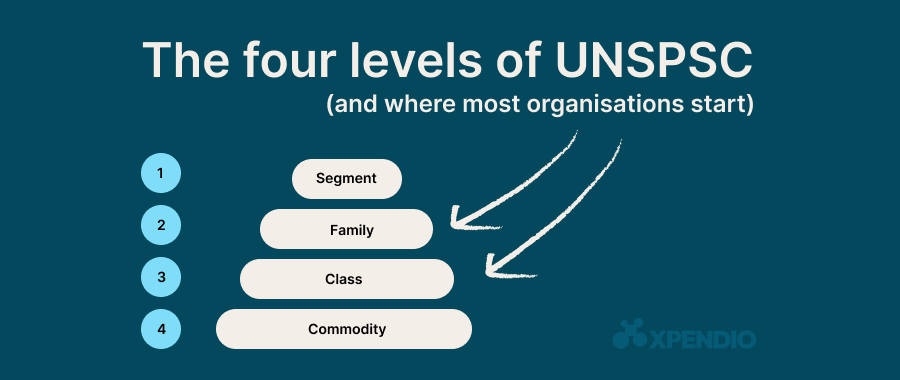
UNSPSC has four levels that describe goods and services, from broad categories down to more detailed classifications.
You do not have to use every level. In our experience, most organisations can get a long way with the two middle levels: Family and Class.
The aim is not to achieve perfect precision in every detail. It is to give the data a stable structure that you can continue working with.
Why UNSPSC is useful for structuring purchasing data
In public-sector organisations, purchasing data often varies between systems, departments and suppliers. UNSPSC makes it more useful in day-to-day work by:
- making cost analysis faster and more reliable
- simplifying contract follow-up
- providing a clearer basis for category management, rather than simply grouping contracts
- making spend analysis more robust, even when some data is incomplete
- reducing the need for manual interpretation
In brief, UNSPSC makes it easier to see what you are buying – and how you are buying it.
When UNSPSC works – and when it doesn’t
UNSPSC is not a magic solution that fixes all your purchasing data overnight. It is a useful framework with both strengths and limitations.
UNSPSC works particularly well when:
- you want an overview without starting with a major data-cleaning project
- you need to compare purchases across different parts of the organisation
- you are carrying out basic cost or spend analysis
- you are introducing or developing category management
- suppliers use very different descriptions for similar goods or services
UNSPSC is less suitable when:
- the data is extremely specialised
- you need a structure designed specifically for your organisation
- you expect UNSPSC alone to solve every data-quality issue
It is a useful tool, not a solution to everything. Keeping these points in mind will help you focus on the problems that UNSPSC is actually designed to solve.
How to get started without getting stuck
- Export the data as it is.
- Start there. You do not need to clean everything first.
- Choose a suitable level. Most organisations can get a long way using the Family or Class level.
- Classify 75–95%, not everything. It is normal for some data to require more thought. You do not need to get 100% right from the start.
- Build on the structure over time. Let UNSPSC support the development of your work, rather than allowing the classification process to control it.
How UNSPSC relates to category management
UNSPSC is not the same thing as category management, but it provides a structure that makes categories easier to create and maintain.
When data becomes more consistent and is grouped clearly, you can begin to work in a much more structured way. For example, you can:
- see where costs are concentrated
- identify patterns and exceptions
- compare suppliers
- have better discussions with different parts of the organisation
- make faster decisions about what action to take
This is often where the difference becomes most noticeable.
How to know whether it is working
It is possible to introduce a new way of working and still wonder whether you have done it correctly. With UNSPSC, the best approach is to look at the effects you can actually see. When several of them are present, the structure is clearly creating value.
Analyses are likely to take less time. Categories that were previously inconsistent begin to fit together more clearly. Supplier data requires less manual work. There are fewer exceptions, the data is better organised and internal discussions have a firmer basis.
These are small but important signs that the structure is working. When those effects do not appear, it may be worth taking a step back and checking whether the foundations are in place.
Conclusion
UNSPSC does not have to be a major project or a technical hurdle. It is a tool that makes purchasing easier to understand and supports better decisions, without requiring everything to be perfect from the start. Used alongside other methods, it can contribute to a more complete picture. In practice, that is often more than enough.