




UNSPSC may sound technical, but in practice it is about something very concrete: being able to...
A spend analysis does not have to be a major project. A simple first pass can quickly give you an overview of costs, contracts and suppliers. That is enough to make better decisions and see where deeper analysis would be worthwhile.
These five steps will help you get there without getting lost in the details.
Why start with a quick spend analysis?
A spend analysis is one of the simplest ways to gain control of purchasing and see where the money actually goes. It answers basic questions such as what you buy, which suppliers you buy from and which contracts apply – or whether contracts are missing altogether.
This can take you surprisingly far. For many procurement teams, especially in smaller municipalities, the immediate goal is to get things right and establish an overview quickly.
A first version should not try to be perfect. It should be good enough to support decisions.
Step 1: Gather the most important data sources
You do not need everything. Start with:
- accounts payable data from the past 12 months
- a list of current contracts
- a simple export from your procurement system, if you have one
This is enough to create an initial cost analysis and identify possible risks or duplicate purchases.
Step 2: Clean only what needs cleaning
A common trap is trying to clean up everything. It is difficult, time-consuming and, in most cases, the wrong approach.
Instead, do only what is needed to make the data usable:
- merge duplicate supplier records
- correct obvious spelling errors
- mark an item as “uncertain category” rather than guessing
The goal is to create an overview, not a final report.
Step 3: Group purchases into simple categories
You do not need full category management from day one. Start with broad, easy-to-understand groups such as:
- IT and technology
- construction and property
- consultancy services
- vehicles and travel
- other
The point is to answer a few questions quickly:
- Where is spend highest?
- Where is control missing?
- Where are contracts missing?
This step creates a natural bridge to category management when you are ready to go deeper.
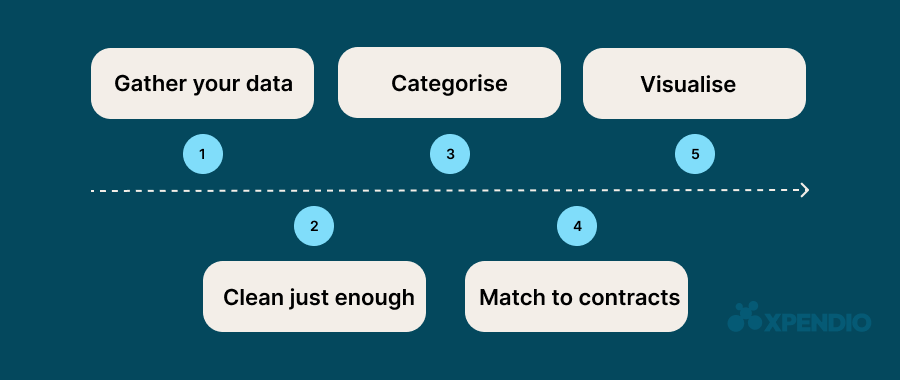
Step 4: Match purchases against contracts and identify gaps
This is where some of the most valuable insights begin to appear:
- Which purchases are covered by contracts?
- Which purchases are made outside contracts?
- Which contracts are not being followed, even though they exist?
This often provides one of the clearest benefits of the entire analysis: an initial view of contract compliance without manually searching through folders, SharePoint or email threads.
Step 5: Visualise three things – that is enough
A quick spend analysis only needs a few visualisations:
- spend by category
- spend by supplier
- share of spend covered by contract
That is enough for decision-makers to understand the current position and for the procurement team to say:
“Here are our three largest areas. We know where to start.”
What should you do after the analysis?
Once the initial picture is in place, you can go further:
- Choose one priority category.
- Define the first steps towards category management.
- Address obvious risks or unnecessary costs.
- Discuss how you want to work with data over the longer term.
A quick spend analysis does not replace a dedicated system. But it quickly provides basic control and a clear direction for the work ahead.