



A spend analysis does not have to be a major project. A simple first pass can quickly give you an...
Purchasing is a visible cost in the budget. Less visible is how unstructured purchasing data affects day-to-day work across the organisation. When figures do not add up, confidence in the data drops, decisions take longer and friction builds. It is easy to get used to, and easy to underestimate. Here is what that looks like in practice.
Without a digital overview, you lose sight of purchasing
In organisations that need to make many decisions every day, data is not simply a support tool. It is a prerequisite.
Without a digital overview, no one can say for certain what is being bought, at what price, from which suppliers or under which terms. This makes it difficult to manage categories, follow up contracts or even understand the risks involved.
The result is not only that costs increase, although they do. More seriously, managers and operational teams lack the evidence they need to make decisions that hold up over time.
Everything becomes a little less certain, a little more reactive and much more dependent on individual people.
When decisions are made without facts, the organisation becomes harder to steer
When information is fragmented or out of date, decisions are more likely to be based on tradition, personal judgement and old assumptions.
Many organisations will recognise this, especially municipalities, regions and other large public-sector organisations. A procurement process begins without a clear view of volumes, or a contract is extended without anyone really knowing how it is being used in practice.
This creates a way of working that depends on knowledge held by individual people. When key employees leave, much of the structure disappears with them.
That costs both time and quality, because every new process has to begin from scratch.
When procurement starts without enough preparation, momentum is lost
Much of the quality of a procurement process is determined before the process itself begins.
Without digital data, it is harder to set the right requirements, understand what the market can offer and estimate realistic volumes. Procurement takes longer, and the resulting contracts are less precise than they could be.
This is not simply about producing better tender documents. It is about giving suppliers the opportunity to respond with their best solutions.
When the information is unclear, both the organisation and the supplier lose out.
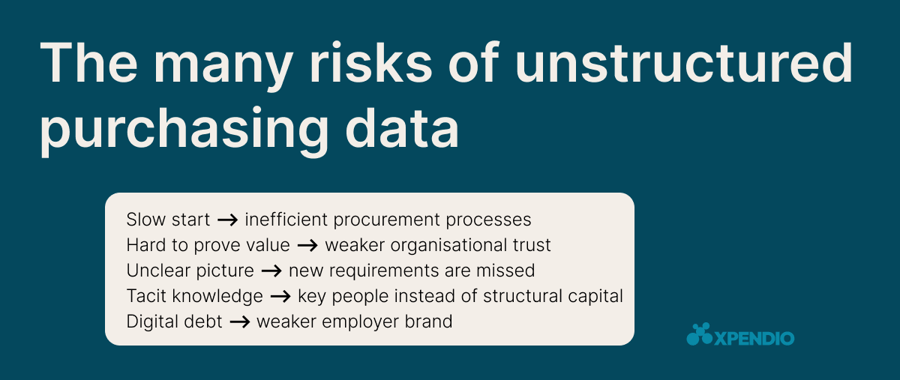
When day-to-day work is messy, culture suffers
Outdated ways of working make it difficult for people to feel that they are doing things properly. Contracts sit in folders, invoices are followed up manually and no one is quite sure whether purchases actually comply with what has been agreed.
This creates a culture where people do the best they can, but the system around them does not help them succeed. Employees often feel that they should be getting more done, while much of their time is spent simply trying to establish the facts.
It becomes difficult to feel effective, which affects both job satisfaction and engagement. At that point, it is clear what needs to change: the system around them.
When the organisation does not modernise, recruitment becomes harder
Newly qualified economists, analysts and procurement professionals expect modern tools, clear ways of working and a data-driven culture.
When the reality consists of manual processes, outdated systems and poor visibility, many choose another employer.
This is a quiet but costly consequence. It becomes harder to recruit, harder to retain people and harder to develop existing expertise. And when the right expertise is missing, modernisation becomes even more difficult. It is a vicious circle.
When the value is hard to see, trust weakens
Public-sector organisations are expected to provide transparency, accountability and public value.
Without reliable purchasing data, it is difficult to show:
- whether contracts are being followed
- how costs are developing
- how purchasing contributes to sustainability
- where the risks are
- what value is actually being created
The work becomes less visible, even though many people are doing important and demanding jobs.
When the organisation falls behind, future demands become harder to meet
Requirements are changing quickly: sustainability, traceability, EU directives, risk management, cybersecurity and reporting.
All these areas depend on organisations having a clear view of their purchasing.
When ways of working are outdated, new requirements become harder to meet – and it becomes even harder to prepare the organisation in time.
This is not about digitising procurement for its own sake. It is about giving the whole organisation the ability to keep pace with change.
What is actually lost
It is easy to think that this is mainly about money. In practice, what is lost is the ability to:
- work more intelligently
- avoid unnecessary disruption
- make everyday work easier for the organisation
- strengthen relationships with suppliers
- follow up properly
- build expertise for the future
- free up time for work that creates real value
When procurement is modernised, the organisation regains control, calm, confidence and the capacity to plan ahead.
These are the capabilities that affect residents, students, patients and service users every day.
Conclusion
Modernising procurement is not about systems or technology. It is about making it possible to steer more effectively, deliver better services and use public funds in a way that strengthens both operational quality and people’s working day. That is why modernisation is not a technology project. It is a decision about how the organisation should work.