




Every organisation wants to contribute to sustainable development. But when it comes to...
Supplier dialogue does not have to be a major project. It is about understanding how the relationship works in practice. In public-sector organisations, where contracts often span several departments and run for years, a good dialogue gives a clearer view of quality, costs and risks. This guide sets out 12 practical steps for running and following up supplier dialogues.
Why supplier dialogue matters
A structured dialogue helps you:
- understand how quality, price and delivery work in practice
- identify problems early and avoid surprises
- improve contract compliance and reduce deviations
- prepare future procurement processes using better information
- develop the relationship and create greater predictability
Supplier dialogue is not simply nice to have. It affects costs, quality and day-to-day operations.
How to prepare for the dialogue
- Gather the data you need. Review spend analysis, contracts, invoices, volumes and any deviations. Start with what is actually happening today.
- Check with the people using the contract. Ask what works, what does not and what needs to be discussed. This gives you both context and specific examples.
- Set a clear purpose and agenda. A clear agenda gives the dialogue focus and reduces the risk of moving into unrelated issues.
Supplier dialogue in 12 steps
--> Step 1: Clarify requirements and expectations internally
What does the contract say? What does the organisation need? What would you like to understand better?
Why: This prevents misunderstandings and unnecessary detours during the dialogue.
--> Step 2: Gather purchasing data and invoices
Review volumes, line-item prices and any deviations.
Why: This gives you a fact-based starting point rather than a general impression.
--> Step 3: Check contract compliance
Do the purchases match the contract? Are the correct goods or services being bought?
Why: Poor contract compliance is often one of the largest hidden sources of cost.
--> Step 4: Review prices and price deviations
Have prices gradually increased? Have agreed discounts been applied?
Why: A clear picture of pricing creates a fair starting point for the dialogue.
--> Step 5: Analyse quality and delivery reliability
Have you received what was agreed? How do the people using the contract experience the deliveries?
Why: Day-to-day quality is often more important than price alone.
--> Step 6: Review how delivery terms work in practice
Consider delivery methods, times, freight and warranties.
Why: Agreed terms and day-to-day reality do not always match.
--> Step 7: Assess flexibility and adaptability
How well can the supplier respond when your needs change?
Why: Public-sector organisations often face changing circumstances, and suppliers need to be able to adapt.
--> Step 8: Address sustainability and ethics where relevant
Discuss environmental requirements, working conditions and other standards that matter within the category.
Why: This creates greater confidence and predictability ahead of future procurement processes.
--> Step 9: Identify risks that could affect operations
Consider capacity problems, lead times, financial stability and dependencies.
Why: Risks are less costly to manage when they are identified early.
--> Step 10: Discuss support and service
Which contact routes are available? How quickly do you receive help?
Why: Support issues have a direct effect on day-to-day operations.
--> Step 11: Compare with other suppliers
Use spend data or independent reports as your reference point, rather than material from competing bids.
Why: This provides useful perspective without creating problems under public procurement rules.
--> Step 12: Plan long-term follow-up
Agree on frequency, responsibilities and a recurring agenda.
Why: Supplier dialogues have little effect without clear follow-up.
Three principles for keeping the dialogue constructive
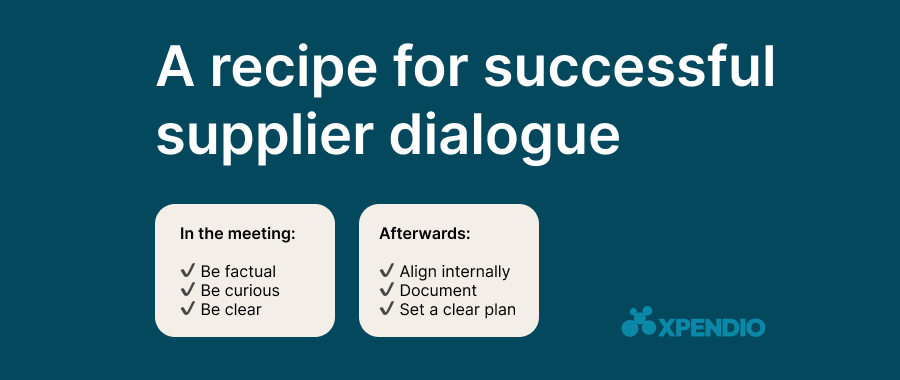
- Be factual. Describe the situation using data. Avoid assumptions, whether positive or negative.
- Be curious. Ask questions that help you understand the reasons behind an issue: “What is causing this?” and “What would make this easier?” This builds trust.
- Be clear. End with specific agreements: what will be done, when it will happen and who is responsible.
How to follow up after the dialogue
Start by sharing the outcome internally. Summarise what you agreed and what it means for the organisation.
Then document the actions and keep it simple:
- what needs to be done
- who is responsible
- when you will follow up
Set a clear plan for continued follow-up. Regular dialogue makes the relationship more stable and helps category management become less reactive.
Conclusion
Supplier dialogue does not need to be more complicated than this. With a simple structure, the right questions and clear follow-up, the relationship becomes more predictable and effective – for both the supplier and the organisation.